What’s the Johari Window?
The Johari Window is a tool created to help people create better understanding and relationships between themselves and each other. It is invented by two psychologists, Joseph Luft and Harrington Ingham in 1955.
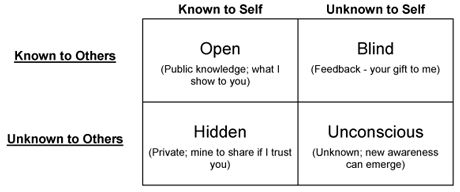
The 4 quadrants of the Johari Window is described as such;
- Open – Characteristics that both the subject and his peers are aware of.
- Blind – Characteristics that the subject DO NOT know, but their peers perceive that of the subject.
- Hidden – Albeit the opposite of blind, characteristics of the subject that himself/herself only knows and not to the public.
- Unconscious – Characteristics that both the subject and peers do not know of.
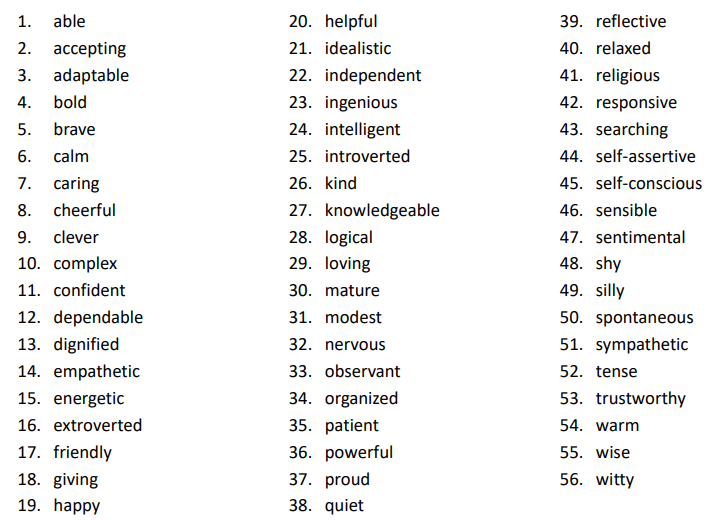
The Johari Window then uses a list of adjective that would describe a person, and then another individual (normally a relative of the person being “tested”) will then sort those adjectives into the respective quadrants that fits into the person’s characteristics.
Test Case – Myself
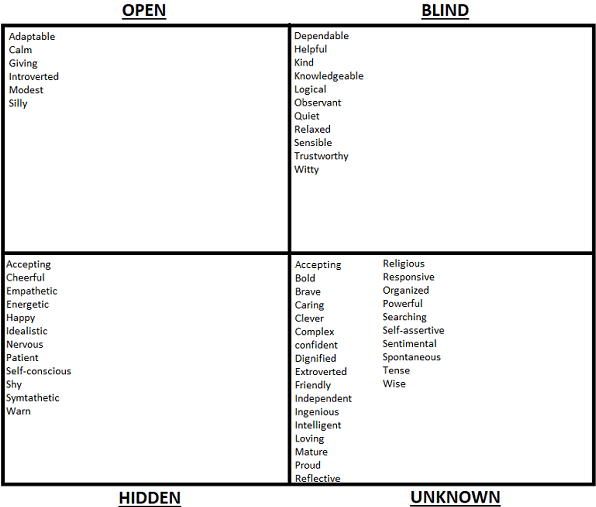
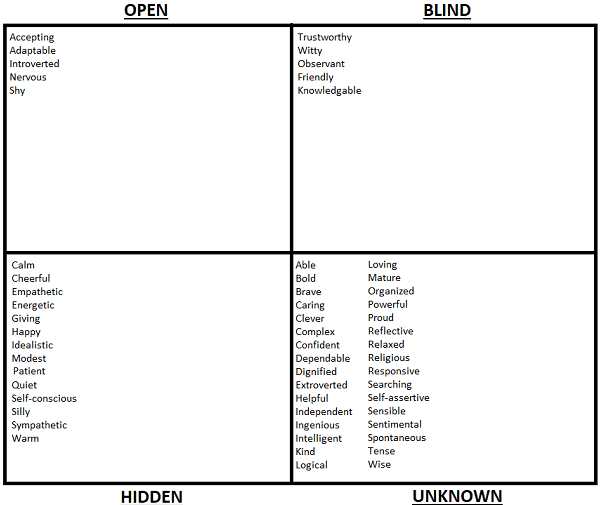
I got two of my friends to assist me in doing up my own Johari Windows and here are the results.
And,
How accurate is this?
From the window, some of the characteristics ended up in the same quadrant, and some did not. Window 1 was done by a peer who has known me longer, and was able to find out more characteristics than the peer which did window 2, who only knew me for a shorter period.
I would say that this model is accurate to a certain extent due to the fact that this model has multiple constraints that could limit its effectiveness. For example, the period of the subject and peer knowing each other, the way that they behave around one another, and even the characteristics of the peers themselves could affect the way they see the subject. The more windows the subject’s peer do could also affect the accuracy of the overall results too.
In this case, the model seems like a kind-of accurate representation as quite a few of the characteristics picked by my peers did fall into the Open or Blind section. (Although window 2 has lesser characteristics chosen for me)
Are there any areas that I’m surprised with?
So far from what I could see, I’m not really surprised about the overall results of this test. I trust my friends very well from what they can see in me 🙂 .
How can the results help in being more self-aware and communication in a team?
The results can definitely help out in both ways. The results of the Johari Window can allow oneself to find out what their peers know of his/her characteristics and thus enable them to know what characteristics they would want to present when interacting with his/her peers in the future.
In a team, members can firstly find out what is the characteristics each other and could then be able to adjust the way they would work with each other to ensure that there would be no miscommunications within the team. This would result in a better working environment without any conflicts within the team.
Conclusions
This test has allowed me to know not only the techniques that can allow their peers to realize what they see in the subject, but also how the subject’s behaviour has influenced the people around him/her. Also, letting the subject know him/herself more would allow for better communication with their peers in the future. As for myself, i have more to work on to become a better person! 🙂
References
- Johari Window Image – http://blog.readytomanage.com/coaching-models-johari-window/
 Hello and Welcome!
Hi Joe, Great analysis of the Johari Window Model. You have explained the model very clearly. I like that you have choose to do the analysis with a person who knew you for a short while and another friend whom you have known for a long time. It helps you to compare and understand people’s perspective about you. I agree with you that this model allows us to understand our personality, self-awareness and allows oneself to learn the different traits that another person perceive you which you may not be aware of. The only criticI have the font size used on the adjectives can be bigger. Looking forward for your next post. Cheers!
LikeLike
Hello Joey, Leon here! Your blog is very well paced and not too draggy. You gave a brief summary of the Johari Window and you answered the question straight to the point. One way that your post can be improved on is the size of the words in the table. You could fully utilise the whole space of the window for each section instead of squeezing everything to one corner.
I agree with your point about “…can allow oneself to find out what their peers know of his/her characteristics and thus enable them to know what characteristics they would want to present when interacting with his/her peers in the future.” As the saying goes, “There is no ‘I’ in team”. Being able to better portray to your teammates allows you to be a better team player as there will be less chance of miscommunication.
Thanks for sharing and I look forward to your next post!
LikeLike